The Enduring Legacy of Myeongdong Donkatsu: Unveiling Seoul’s Foundational Cutlet Institution Since 1983
This comprehensive, in-depth guide is dedicated to Myeongdong Donkatsu, the historic establishment founded in 1983 that pioneered the thick, Japanese-style pork cutlet in Korea. We delve into the restaurant’s 42-year tradition, meticulously detailing its unique atmosphere, the unparalleled systematic service, and the culinary secrets behind its signature Codon Bleu and perfectly prepared Hirekatsu. This article covers essential information on the menu, pricing, and precise location details, serving as your complete reference for visiting this irreplaceable Myeongdong institution.
Have you ever found yourself caught in the whirlwind of Myeongdong, that pulsating heart of Seoul, and suddenly felt a profound, deep-seated yearning for a truly exceptional meal?
I’ve walked those vibrant streets countless times, believing I was intimately familiar with every culinary corner, only to realize I had a massive, historical gap in my dining education. The simple desire for a donkatsu—the Korean adaptation of the Japanese tonkatsu—led me to seek out something beyond the ordinary, something that carried the weight of time and impeccable quality, and that path inevitably led right to the heavy, familiar door of Myeongdong Donkatsu.
This is not a fleeting trend or a newly discovered sensation. This is the root of all roots (geunbon jung-ui geunbon) when it comes to the Japanese-style pork cutlet in Korea. This single establishment is credited with being the first in the entire country to introduce and popularize the thicker, more substantial cutlet, a culinary revolution that started a tradition spanning over 42 glorious years. It’s an absolute landmark and a true nopo (old, respected establishment) of Myeongdong. In this extensive guide, I want to share every detail of this incredible spot, from the palpable history you feel upon entry to the precise texture of their famous Hirekatsu and the unique, savory explosion of their signature Codon Bleu. Prepare for an immersive look into a place that truly defines a genre in Korean dining. Let’s begin this fascinating journey! 🤤

The Unfolding of a Tradition: Four Decades of Myeongdong Donkatsu History ⏳
The story of Myeongdong Donkatsu is fundamentally linked to the modern evolution of Korean cuisine, specifically marking the transition from thinner, more typical Korean-style donkatsu to the globally appreciated, thick, fried Japanese style.
The restaurant proudly claims its founding in 1983. To put this in perspective, for 42 years, this restaurant has been operating continuously from a single location in one of the most commercially dynamic areas of Seoul, making it an extraordinary Myeongdong resident and landmark (teotju-daegam). This deep, unbroken history is the first layer of its identity.
The real significance, however, lies in its pioneering role. The founder of Myeongdong Donkatsu took the initiative to travel and learn the meticulous preparation techniques from one of Japan’s celebrated donkatsu masters at a restaurant known as Donki. This was a deliberate effort to bring a superior, authentic version of the dish to Korea.
This Japanese technique, emphasizing the thickness of the pork and the quality of the frying, was revolutionary in Korea at the time. This establishment was the first in Korea to introduce and serve the thick, Japanese-style cutlet, thereby setting a new standard that would eventually be adopted nationwide. This singular act established the restaurant’s reputation and gave birth to the phrase ‘Myeongdong Donkatsu’ as a distinct and highly respected genre of food.
Walking into this place means stepping into a living piece of culinary history. It is a true nopo—an old, respected store—whose roots run deep, offering a taste that has been perfected over generations, untouched by fleeting trends.
The Presence in Myeongdong’s Landscape
Myeongdong is characterized by its flashy, modern, and high-turnover commercial district, yet Myeongdong Donkatsu holds its ground with a weighty, almost stoic presence.
Its exterior is neatly organized and well-maintained, a clear indication that the business is managed with pride and meticulous care, despite the ravages of time and the constant change around it. The exterior does not look old or shabby; instead, it conveys a profound sense of enduring quality and reliability.
The authenticity of its tradition is subtly communicated through the use of Chinese character (Hanmun) notations throughout the premises. This is a crucial detail: these notations are not a deliberate, intentional concept designed to create a modern ‘retro’ feel, but rather a simple continuation of how the restaurant has marked its signs and information since its true early days. This unpretentious, original appearance is deeply appealing to those who appreciate genuine history and tradition.
This subtle commitment to its original identity, combined with a consistent focus on a single core dish, is why Myeongdong Donkatsu is correctly hailed as a defining representative food of the entire Myeongdong area. It is a pillar of the local dining scene, known for its deep-rooted, unchanging flavor and quality.

The Unique Atmosphere: Live Kitchen Action and Service Excellence 🔪
The moment you step inside Myeongdong Donkatsu, you are greeted by an atmosphere that is both historical and surprisingly modern in its efficiency, a dichotomy that is rarely achieved in long-standing restaurants.
The first element to immediately capture your attention is the Bar-Style Kitchen, which is situated right at the entrance of the first floor. This is not a hidden back room; it is an open, interactive space where the chefs are actively and expertly frying the donkatsu live. This visual spectacle immediately builds anticipation and acts as a central focal point for the entire dining area.
It is truly astonishing to consider that this system—an open, bar-style kitchen—has been operational since 1983. In today’s dining landscape, this structure is common, but Myeongdong Donkatsu implemented it decades ago, demonstrating a visionary approach to customer engagement and transparency in preparation. The front section of the first floor features counter seating (dachi) which allows patrons to sit right at this bar, literally getting their cutlets the moment they are taken out of the fryer, which is the absolute peak of freshness.
A major testament to the restaurant’s operational quality is the environment surrounding this active frying station. Despite the constant, high-volume preparation of deep-fried food, the area is impeccably managed. There is virtually no deep-fried oil smell clinging to the air, and the staff’s dedication to maintaining the cleanliness and quality of the oil is palpable. This results in a dining experience that is remarkably pleasant and comfortable, which is a rare feat for a cutlet specialty store.
Myeongdong Donkatsu offers two distinct dining environments across two floors. For the most immersive, sensory experience, choose the 1st floor counter seating, where you can watch the precise, careful work of the chefs. If you prefer a more traditional dining setup with a view, request the 2nd floor table seating, which allows you to look down upon the dynamic, bustling cityscape of Myeongdong while you eat. Both floors are equally well-serviced, but they offer completely different, appealing perspectives.
The Pillar of Systematic Service
The efficient organization extends directly into the service model, which is a cornerstone of the restaurant’s success and ability to handle large volumes of customers in a central location.
The entire operation is highly systematic. The restaurant has many staff members assigned to each floor (1st and 2nd), ensuring that the service is organized, quick, and friendly. This level of staffing and operational refinement is a clear indicator of a business that has successfully fine-tuned its processes over four decades.
Even during peak periods, the efficiency is such that the dining environment never feels overcrowded or rushed. Orders are taken quickly, and the time from ordering to receiving the food is exceptionally fast, a direct benefit of the well-oiled, systematic management. This dedication to quick, yet attentive, service is why Myeongdong Donkatsu maintains such a stellar reputation even among modern, tech-forward competitors.
The commitment to a pleasant experience is also reflected in the small details, such as the water served. The liquid in the quaint, nostalgic glass water bottle is barley tea (boricha), a warm and comforting choice that subtly aids digestion and provides a traditional, gentle counterpoint to the savory fried food.
The Menu Philosophy: Concise Confidence and Pricing 💵
The menu at Myeongdong Donkatsu is immediately striking for its brevity and focus, a sign of a kitchen that trusts the quality of its core product implicitly.
The presentation of the menu is clean and simple, conveying a sense of refinement and absolute confidence in the handful of items offered. There is no need for excessive side dishes or distractions; the focus is squarely on the perfectly fried cutlet and its immediate companions.
The anticipation for the meal begins the moment you are seated, as the savory scent of expertly fried food, characterized by a clean and wholesome aroma, fills the air. This is the scent of properly managed, fresh oil and high-quality ingredients, a promise of the meal to come.
The main dishes, all centered around cutlets and fries, are competitively priced, with the general price range for the main cutlets being in the 10,000 KRW range. Given the restaurant’s historical significance, its prime location in Myeongdong, and the undeniable quality of the product, this pricing represents excellent value for a truly iconic Seoul dining experience.
The Full Menu and Detailed Pricing
The menu is a curated list of six items, perfectly balancing classic offerings with the restaurant’s unique, signature creations. Every item on the list is a testament to the focused culinary philosophy of the establishment.
The Roskatsu and Hirekatsu represent the traditional pillars of tonkatsu, offering the two distinct cuts of pork. The Fish Katsu and Shrimp Fry provide alternatives for those seeking seafood, executed with the same high standard of frying. Finally, the Codon Bleu and Chicken Bleu showcase the restaurant’s inventive spirit, combining the familiar cutlet form with creative fillings.
Knowing the precise cost is crucial for planning your visit. The consistent pricing of the specialty “Bleu” items at 19,000 KRW reflects the extra labor and complexity involved in their preparation compared to the traditional cuts.
| Menu Item (English) | Korean Name | Price (KRW) |
|---|---|---|
| Roskatsu (Pork Loin Cutlet) | 로스가스 | 15,000 |
| Hirekatsu (Pork Fillet Cutlet) | 히레가스 | 16,000 |
| Fish Katsu | 생선가스 | 14,000 |
| Shrimp Fry | 새우후라이 | 19,000 |
| Codon Bleu (Signature) | 코돈부루 | 19,000 |
| Chicken Bleu | 치킨부루 | 19,000 |

The Legendary Codon Bleu: A Deep Dive into the Signature Dish 🥇
While all the cutlets at Myeongdong Donkatsu are prepared with excellence, the Codon Bleu (코돈부루) stands out as the restaurant’s true signature masterpiece, a dish that has cemented its unique place in the Korean donkatsu world.
This dish is not a standard item you find everywhere; it is a complex, labor-intensive menu item that requires significantly more precision and time to prepare than a simple Roskatsu or Hirekatsu. The fact that Myeongdong Donkatsu has diligently maintained the high standards and exact preparation method for this complicated dish over decades is a monumental achievement in culinary consistency.
The meticulous process begins with the pork loin (Roskatsu meat), which is carefully sliced and thinned out. This thin sheet of meat is then used as the wrapper for the stuffing. The interior is a delightful, savory blend of filling ingredients: chopped vegetables (specifically mentioned as bell peppers/capsicum and onions) and melted pizza cheese.
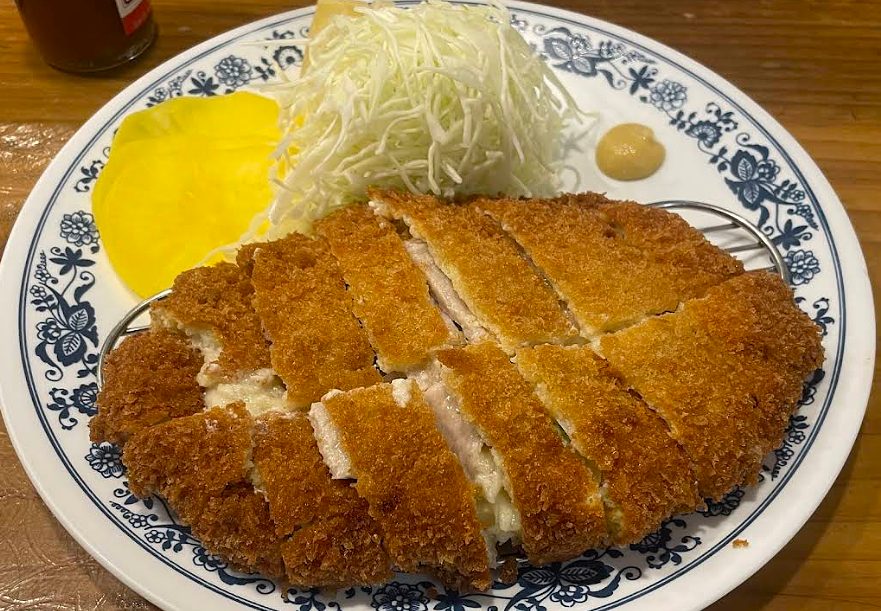
These ingredients are rolled tightly together inside the pork loin, sealed, and then fried perfectly. The outcome is a cutlet that, when sliced, reveals a glorious cross-section of oozy, melted cheese and vibrant, slightly softened vegetables. Each bite delivers a perfect combination of savory richness from the cheese and a faint, sweet undertone from the vegetables, all enveloped in the restaurant’s signature, light, crispy batter.
The Codon Bleu is a flavor journey: the initial crunch of the exterior gives way to the tender pork, followed immediately by the burst of the aromatic, creamy filling. This specific marriage of textures and tastes is what makes the dish unforgettable and explains its status as a must-try for any visitor.
For those who appreciate a balance of richness and sharp acidity, the restaurant’s unofficial suggestion is to try the Codon Bleu with Tabasco sauce. A few sprinkles of Tabasco across the cut surface of the Codon Bleu can introduce a necessary, tangy kick that brilliantly cuts through the dense flavor of the cheese and pork. This is a highly recommended modification to maximize the complexity of the dish and enjoy it as local connoisseurs do.
The Uncompromised Quality of Hirekatsu (Pork Fillet)
While the Codon Bleu is the flashiest item, the Hirekatsu (히레가스), or pork fillet cutlet, showcases the kitchen’s pure mastery of the fundamental cutlet technique.
The defining characteristic of the Hirekatsu here is the meat itself. The fillet is noticeably thick, providing a generous and hearty mouthfeel, yet the inner flesh remains astonishingly soft and tender. This dual quality—thick and tender—is the result of expert preparation and sourcing of high-quality pork.
The exterior is fried to a perfect, audible crispness, creating a superb crunchy texture that beautifully contrasts with the soft interior. This textural excellence is paired with a critical health and flavor benefit: the cutlet has almost no residual oil. This non-greasy quality is the restaurant’s greatest strength, ensuring that the dish feels light and easy on the stomach, even after finishing the thick portion.
The thinness of the frying coat is key to this delicate balance, as it ensures that the meat’s inherent flavor remains the primary focus of the dish. When combined with the house sauce, the Hirekatsu achieves a magnificent balance between the clean, savory pork and the complementary salty and savory notes of the sauce, never allowing either component to dominate.
The Supporting Ensemble: Rice and Miso Soup
The overall dining experience at Myeongdong Donkatsu is elevated by the quality and thoughtful placement of its side dishes, namely the rice and the miso soup (miso-jangguk).
Both the accompanying rice and the miso soup are noted to be excellent, a sign that the kitchen pays attention to every detail of the meal, not just the centerpiece. The role of the side dishes is not merely to fill the plate, but to complement and perfect the cutlet.
The warm, savory miso soup is essential for providing balance. Taking a spoonful of the soup immediately after biting into the crispy, fried cutlet works wonders; it gently cleanses and softens the palate, preparing the diner for the next bite of rich pork. This carefully calculated sequence of flavors creates a perfect balance that completes the entire culinary experience, demonstrating a profound understanding of how flavors and textures interact in a meal.
Visitor’s Guide: Location, Hours, and Accessibility 🚉
To ensure a seamless visit to this historic Seoul restaurant, having all logistical information precisely mapped out is essential.
Myeongdong Donkatsu is located in the central and highly accessible Jung-gu district of Seoul. Its address is 8, Myeongdong 3-gil, Jung-gu, Seoul (Myeongdong 1-ga), with the postal code 04534. This location places it right in the commercial heart of the Myeongdong area, a short walk from major transit hubs.
The restaurant operates on a highly consistent schedule, open seven days a week, from Monday through Sunday, providing ample opportunity for visitors to experience its legendary food. Their hours of operation run from 11:00 AM until 9:00 PM (21:00), offering a long window for lunch, dinner, or a mid-afternoon meal.
The only days the restaurant closes are during the major national holiday periods, specifically the Lunar New Year and Chuseok holidays. This limited closure schedule further confirms its status as a consistently available and foundational piece of the Myeongdong dining structure.
For travelers relying on Seoul’s efficient subway system, Myeongdong Donkatsu is best accessed through Euljiro 1-ga Station.
This station is part of Subway Line 2. Visitors should use Exit 6 of the station, which puts the restaurant just 244 meters away, a very short and manageable walk. This high degree of accessibility ensures that you can quickly transition from the subway to your seat without extensive navigation through the busy streets.
For direct communication or to confirm any details, the restaurant can be reached by telephone at 02-775-5300. It is always wise to note the hours and phone number, especially when planning a visit during or near major holiday periods, to avoid any unexpected delays or closures.
Quick Reference Guide
- Restaurant Type: Traditional Restaurant (Eumsikjeom)
- Signature Menu: Donkatsu
- Price Range: 10,000 KRW range
- Full Address: 8, Myeongdong 3-gil, Jung-gu, Seoul (Myeongdong 1-ga), 04534
- Nearest Subway: Euljiro 1-ga Station (Line 2, Exit 6)
Visualizing the Location: Interactive Map and Directions 📍
To finalize your travel plans, here is the exact location of Myeongdong Donkatsu visualized on a map. Knowing precisely where the restaurant is situated ensures you can enjoy the delicious Codon Bleu and Hirekatsu without any navigational delay.
Its central location is a major benefit, easily locatable from the subway exit. Use the interactive map and the external link provided below to save the location directly to your navigation app.
Final Thoughts: A Legacy of Quality and Consistency 💯
Myeongdong Donkatsu is far more than simply a place to eat; it is a profound cultural landmark that has expertly refined a single dish over 42 continuous years of operation.
Its enduring success lies in an uncompromising dedication to core principles: the pioneering introduction of the superior Japanese-style cutlet, an extraordinary commitment to non-greasy frying through meticulous oil management, and a highly systematic service structure that ensures a smooth and pleasant experience for every diner. This commitment to quality in every detail, from the thick, tender Hirekatsu to the perfectly balanced miso soup, is why it has earned the title of the “root of all roots” of Korean cutlet culture.
Whether you choose the traditional path of the unadulterated Hirekatsu, which showcases the natural flavor of the pork, or venture into the creative complexity of the cheese-and-vegetable-filled Codon Bleu, you will be participating in a genuine piece of Seoul’s culinary history. I encourage every visitor to Myeongdong, and every local seeking the authentic original, to pay their respects to this incredible institution.
Go, taste the tradition, and experience the profound consistency of a restaurant that has been mastering its craft since 1983. Don’t forget to try the Codon Bleu with a dash of Tabasco! Enjoy! 😊